
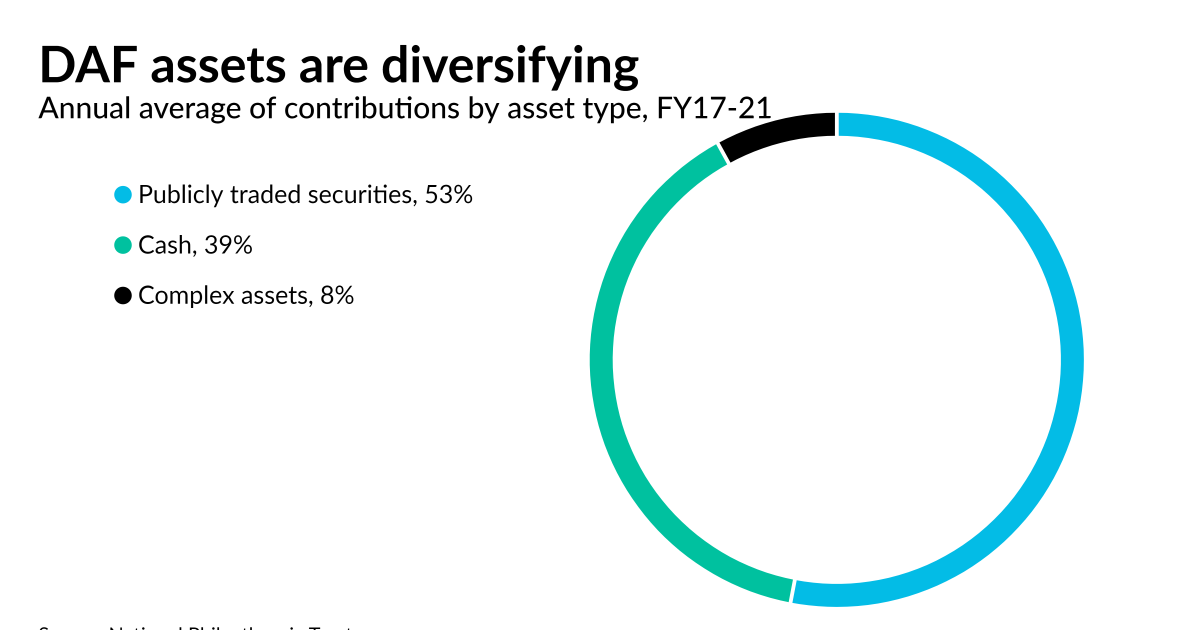
Donor-advised funds have been receiving greater than half of their contributions from complicated belongings resembling shares of private and non-private firms, actual property and cryptocurrency prior to now 5 years, based on a brand new report.
The report, launched final week by the Nationwide Philanthropic Belief, which manages DAFs on behalf of shoppers, discovered that persons are utilizing noncash belongings, together with publicly traded securities, actual property, artwork, jewellery, collectibles and privately held enterprise shares to fund their long-term philanthropic imaginative and prescient and make strategic monetary decisions.
In response to the report, 61% of contributions to NPT’s DAFs, on common over the previous 5 years, have been illiquid belongings resembling shares of privately held companies, together with shares, cryptocurrency and actual property. Publicly traded securities made up 53% of DAFs, adopted by complicated belongings at 8% (each of that are illiquid) whereas money made up 39% of contributions.
DAFs and personal foundations have change into an more and more well-liked automobile for charitable giving, particularly amongst rich people. DAF holders are capable of declare charitable deductions, though they’ve come underneath stress from watchdog teams in recent times to pay out contributions sooner to charities to fulfill pressing wants, particularly through the pandemic.
“We settle for the belongings, to allow them to get no matter deduction they’re entitled to, after which we promote it to get money of their DAF accounts to permit them to be grantmakers,” stated NPT CEO Eileen Heisman. “Typically they’re current donors, so that they’ll have already got a small, medium or giant sum after which we’ll add to it. Typically they provoke their DAF with these illiquid belongings, and because the market has gone up within the final couple of years as they improve in worth — significantly for publicly traded securities, however even with tangible private property — we have seen an excellent curiosity in gifting these.”
She sees DAFs as a option to unlock in any other case dormant belongings for charitable giving.
“Not all people considers that,” stated Heisman. “It is typically pushed by an advisor studying about it or studying about it. When individuals lastly notice that they will do it, and their advisor realizes it, they’re typically very completely happy that they do not need to half with one thing that is of their investments or in money, that they will half with one thing that may be an appreciated asset.”
The cryptocurrency market tumbled this yr after reaching all-time highs final November, and that has prompted traders to chop again on donations of belongings like Bitcoin and Ether.
“Crypto presents had been greater a few years in the past,” stated Heisman. “I do not suppose we have skilled any crypto presents lately. Folks are inclined to reward tangible private property or other forms of belongings like this once they’re extremely valued. Once they’ve dropped in worth, the sellers are inclined to take the loss towards their taxes in the event that they’re utilizing this as a part of their tax planning. There isn’t any cause to reward a depreciated asset as a result of you could as properly promote it and take the loss. Chances are you’ll wish to decide one other asset altogether after which depreciate it. Folks have a tendency to provide the appreciated belongings to their donor-advised fund and never the depreciated ones.”
The noncash belongings can embrace many different sorts moreover crypto. “Within the final 5 years the common has been larger than 50%, which incorporates publicly traded securities, but in addition tangible private property, and what we name complicated belongings, resembling a private curiosity in a enterprise or privately owned inventory or generally partnerships or different methods wherein individuals maintain belongings,” stated Heisman. “We’ll sometimes get a present of personal fairness or a hedge fund curiosity. Typically these are taxable so we won’t promote them instantly.”
NPT wants to ensure earlier than it takes an illiquid asset resembling this that it is capable of maintain it for a time period.
“Typically we expect it is too lengthy, or if we expect there is a danger to any of those belongings, we cannot take them,” stated Heisman. “Now we have an entire due diligence course of with a guidelines earlier than we settle for the asset. There’s numerous backwards and forwards between the donor and advisor. We in all probability flip down about 30% of them.”
Whereas a publicly traded safety is comparatively easy to cope with, tangible private property can contain many extra particulars that NPT has to ask about.
“Each now and again, we’ll get inventory that is from a director, founder or anyone who’s an proprietor in some way or has gotten inventory throughout a public occasion,” stated Heisman. “If it is a publicly traded inventory that is restricted, in that case we both need to get the restrictions lifted or wait till there is a window to promote it. Typically we settle for these presents and different instances we resolve to not promote them, so we have a look at every one rigorously and distinctly.”
Watchdog backlash
Watchdog teams have argued that DAFs are capable of maintain such belongings for much too lengthy whereas ready to promote them, however allowed donors to say charitable deductions within the meantime on their taxes. Final month, the Institute for Coverage Research launched a report that identified DAFs have change into the fastest-growing recipients of charitable {dollars} within the U.S. in current many years. In 2020, for the primary time, donations to DAFs had been equal to contributions to personal foundations, with each receiving roughly $48 billion from donors. The biggest single recipient of charitable giving within the U.S. for the previous six years has been the Constancy Charitable Reward Fund, a business DAF sponsor, and for the previous three years, six of the highest 10 charities have been DAF sponsors. The report discovered that presents to personal foundations and DAFs now divert practically a 3rd of charitable giving within the U.S.
Giving to personal foundations has additionally elevated from 6% to 15% of all charitable giving since 1992, whereas giving to DAFs has elevated from 4% to 15% of all charitable giving since 2007. Collectively, these charitable intermediaries now take up 30% of all U.S. donations, and have greater than quintupled their share of the charitable pie in lower than 30 years.
“One factor we’re simply seeing is extra individuals opting out of taxes through the use of the charitable deduction,” stated Chuck Collins, director of the Charity Reform Initiative on the Institute for Coverage Research, who co-authored the report. “We wish to encourage individuals to provide to certified charities, however an increasing number of cash is getting waylaid into these intermediaries. The implication is a slowing of cash flowing to charities, significantly from the rich, more cash warehoused in intermediaries, extra rich individuals utilizing philanthropy as an extension of their energy and affect. That really additionally adjustments the recipient tasks. Rich individuals give otherwise than atypical individuals. They’ve totally different priorities, with more cash going to some locations and never others.”
He wish to see tax advisors steering their rich shoppers towards giving out charitable contributions sooner relatively than later.
“I believe the advisors have an enormous position when it comes to teaching or nudging individuals on shifting cash in a extra well timed method,” stated Collins. “Considering when it comes to a legacy orientation would possibly make sense in case you’re doing household wealth administration, however a legacy orientation in philanthropy is problematic.”
The IPS Charity Reform Initiative and the polling agency Ipsos surveyed over 1,000 adults in June and located {that a} broad bipartisan majority of People strongly help reforms that will curtail the warehousing of charitable wealth. Their suggestions embrace requiring DAFs to make well timed distributions to charities in addition to curbing public subsidies of perpetual personal foundations.
“The polling that we did with Ipsos confirmed a wider public need to see cash moved in a well timed method,” stated Collins. “They do not like the concept we as taxpayers need to subsidize legacy perpetual charities. Advisors can play a job in the identical method a health care provider can encourage anyone to plan for a special finish of life.”
He pointed to billionaire philanthropists like MacKenzie Scott or Chuck Feeney as offering constructive examples of charitable giving.
“There’s numerous pleasure in giving whilst you’re alive, in shifting cash for pressing wants and never fascinated by what your nice grandchildren can be doing with the cash, shifting it in the present day,” stated Collins.
He wish to see well timed payouts within the funds rising, maybe as a requirement. “I’d simply say if individuals cannot voluntarily work out transfer it in a well timed method, that is the place a mandate is sensible, simply to maintain the cash flowing, discouraging warehousing,” stated Collins. He pointed to the NPT report exhibiting that almost two-thirds of donors are utilizing DAFs to switch complicated belongings.
“There’s some huge cash being steered to DAFs with a give attention to tax penalties,” stated Collins. “Principally I’d describe it as a design flaw, that you just get your tax break right here and there isn’t any additional incentive to maneuver the cash in a well timed method. That’s an unintended consequence of the 1969 tax legislation. That was not the intent of tax legislation writers in 1969, to create intermediaries that will by no means have an incentive for cash to maneuver to the recipient teams. It is actually nice for the investor, however not so good for the charities.”
Heisman disagreed with the claims within the IPS report of donors warehousing their cash for overly lengthy intervals.
“We do not discover that folks sit on them,” she stated. “Our expertise is that as quickly because it’s liquidated, the donors begin making grants instantly. Our payouts are about 20%, so we do not discover them to be dormant belongings in any respect. We discover the donors to be actually dedicated to eager to help the social sector. I do not know the place they received their knowledge, however we discover donors to be actually lively and engaged.”
Widening vary of donors
She identified that it is not solely the extremely wealthy contributing to DAFs.
“For complicated belongings, it is the wealthier donors, however for publicly traded securities it is an entire vary of donors,” stated Heisman. “You may have individuals who have modest wealth, or who’ve collected some cash, inventory or inherited inventory from members of the family. We discover individuals of all totally different sorts of wealth contributing publicly traded securities and that is not restricted to extremely excessive web price in any respect. You do not have to be a multimillionaire to do complicated belongings. Folks simply occur to personal issues or they invested in one thing early on that is not a publicly traded safety. In actual fact we actually love the concept of unlocking illiquid belongings for charitable giving. We expect it makes the pie of giving out there even larger and donors appear to essentially prefer it. Consider these belongings as in any other case simply sitting there dormant and impulsively they’re transferred, they change into liquid and donors begin to make grants. We expect it is a actually good benefit to the social sector that we now have that form of cash out there and that donors are engaged.”
Two years in the past, most of the DAF contributors really needed their funds to exit sooner in response to the pressing wants of the pandemic (see story), however these priorities have been shifting again to conventional charities.
“I believe pandemic-related causes could have slowed down slightly bit,” stated Heisman. “Individuals are going again to the issues they had been eager about earlier than, the atmosphere clearly, after which in some instances when there is a politically-driven occasion, we would see more cash going to locations like Deliberate Parenthood or ladies’s organizations. Folks will typically search for a charitable group which may mirror a political curiosity they’ve. When there’s been a debate within the public area, we would see more cash going into entities like that. They’re charities, not political campaigns, however they’re expressing their curiosity by their charitable presents relative to one thing that could possibly be a political matter.”
Whereas the markets have been turbulent this previous yr amid recession fears, inflation and rising rates of interest, DAFs are persevering with to attract contributions over the long run.
“If you concentrate on the market in the previous few years, not the final 10 months, the market hasn’t been nice,” stated Heisman. “But when you concentrate on the earlier 5 years earlier than that when the market went up tremendously, individuals noticed the worth of their investable belongings and realized that they may give a part of them and that is what they determined to do. It is also pushed by their monetary advisor, their accountant, or banker or whoever they use.”