
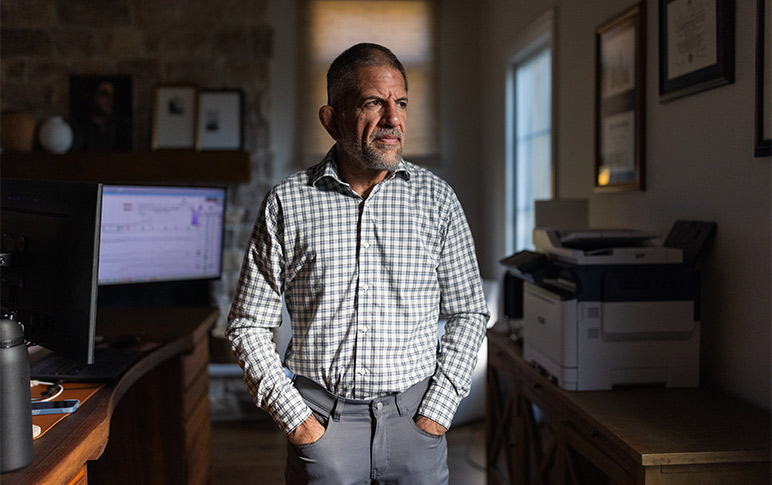
For years, Neil Sethi routinely posted Wall Avenue analysis to construct an viewers on X, spotlighting charts and inventory tricks to his almost 30,000 followers. It was, he believed, a quid-pro-quo association. His model grew, whereas the banks obtained extra publicity from likes and retweets.
All that modified this summer season, when his account, @neilksethi, was suspended after Financial institution of America Corp. accused him of publishing its information with out permission. Although Sethi, who runs a small funding agency from Higher Arlington, Ohio, supplied to by no means use the analysis once more, he hasn’t regained entry to his account, which he cultivated over the previous decade.
“It elevated my visibility to individuals who I wouldn’t have had any relationship with,” Sethi, 54, mentioned. “To have that yanked out from underneath you with none alternative to determine what’s going on or to repair it’s irritating.”
Sethi’s predicament is taking part in out throughout the huge on-line ecosystem colloquially often called FinTwit — brief for Monetary Twitter, a reference to X’s former title. And lots of observers say it displays a brand new, and surprisingly draconian, response by a few of Wall Avenue’s largest names to guard their enterprise fashions by clamping down on who will get to see their analysis.
Over the previous 20 years, strict rules on how banks cost for analysis mixed with the rise of index-tracking funds have gutted analysis departments at corporations huge and small. Now, staggering breakthroughs in synthetic intelligence threaten to commodify their proprietary evaluation as quickly because it’s posted on-line.
“Piracy has been round for many years, it simply has gotten extra well-liked with how simply you will discover these papers with an AI agent or social media,” mentioned Ben Mok, vp of brand name and content material safety at Corsearch, the agency that Financial institution of America used to file the complaints. He declined to debate the financial institution’s particular complaints.
“Now, cybersecurity groups are beginning to concentrate,” he mentioned.
Specifically, web-scraping fashions will incorporate posts containing the banks’ analysis to boost the standard of their solutions, usually with out attribution. The concern is that AI chatbots and brokers will synthesize a lot analysis into their responses that it’s going to render the banks’ studies out of date, or at the least drastically undercut the charges they’ll cost for insights from their analysts.
The banks themselves have been tight-lipped. Financial institution of America declined to touch upon its clampdown, as did Morgan Stanley, which has additionally taken motion in opposition to FinTwit accounts on X.
Goldman Sachs Group Inc. mentioned that it doesn’t enable exterior events to publish analysis studies on social media, in keeping with spokesperson Nick Carcaterra, however declined to debate whether or not it has taken any steps to implement the ban.
Different Wall Avenue corporations, together with JPMorgan Chase & Co., Citigroup Inc. and Toronto-Dominion Financial institution, in the meantime, declined to say whether or not they have taken any such actions. Royal Financial institution of Canada and X didn’t reply to requests for remark.
No less than a dozen FinTwit accounts, from these with a number of hundred to tens of 1000’s of followers, have obtained notices from Financial institution of America or Morgan Stanley citing violations of the Digital Millennium Copyright Act, in keeping with complaints seen by Bloomberg.
Ryan Detrick, chief market strategist at Carson Group Holdings LLC, obtained his first one on Sept. 2 from Morgan Stanley, quickly locking him out of his X account, which is adopted by over 225,000. Mike Zaccardi, a monetary author with over 80,000 followers, mentioned he began receiving DMCA notices on behalf of Financial institution of America round a yr in the past, however the barrage has picked up in current months. Zaccardi and Sethi additionally obtained DMCA complaints from LinkedIn after posting financial institution analysis there as properly.
“There’s extra content material on the market in digital format now, and Gen AI is healthier at discovering issues than the typical human,” mentioned Michael Eastwood, director of Americas fairness analysis at Jefferies LLC. “Now banks are extra uncovered.”
The phenomenon extends properly past Wall Avenue. Industries starting from digital media to e-commerce are scrambling to guard their content material from bots, which now account for 65% of all internet visitors, in keeping with cybersecurity firm Cloudflare Inc.
In a single high-profile case, the New York Instances and Chicago Tribune late final yr sued Perplexity AI Inc., saying the startup copied and distributed their content material with out authorization.
Analysis departments at banks have causes to be notably cautious, following a decade that has seen their status fade and shopper spending dry up.
Laws resembling MiFID II pressured banks to unbundle analysis and buying and selling prices, inflicting analysis budgets to shrink. The proliferation of ETFs has fueled passive investing and made it simpler to commerce broader market themes, taking the highlight away from stock-picking analysts.
In the meantime, once-reliable clients like hedge funds have constructed up their very own in-house analysis groups. In reality, shopper spending on fairness analysis has fallen by 50% since 2018, information from Substantive Analysis present.
Rebecca Tushnet, a professor of First Modification regulation at Harvard Regulation Faculty, mentioned that whereas there’s no copyright safety for details resembling market information, it does apply to the way in which they’re packaged and introduced.
“In the event you simply straight copy it, then sure, there’s a believable case for copyright infringement,” she mentioned.
For his half, Sethi concedes that he didn’t initially ask Financial institution of America for permission to make use of its analysis, which he obtained due to an account he maintains with the agency’s wealth administration arm. He assumed, like many on FinTwit, that he had the banks’ tacit approval.
So did Zaccardi, who discounted the complaints partly as a result of he noticed Financial institution of America’s analysis just about in all places on X.
“Even right this moment, I see accounts which might be nonetheless placing out Financial institution of America stuff on a regular basis, and people accounts are definitely manner larger than mine,” he mentioned.
Regardless of the warnings and potential penalties, Sethi and Zaccardi nonetheless routinely publish analysis from banks, usually together with notes from Financial institution of America. Considerably predictably, on this age of synthetic intelligence, each admitted to utilizing AI to change the charts so they appear completely different from the originals.
The specter of suspension looms as a continuing. But Sethi rationalizes his resolution this fashion: the 9,300 or so customers who observe his new X account stay a fraction of what he amassed along with his outdated one.
“It’s very tough,” he mentioned, “to get these relationships again.”