
The Inside Income Service plans emigrate its set of on-line providers for tax professionals to the third-party supplier ID.me this summer season regardless of objections being raised in Congress to the authentication firm.
The IRS mentioned in an e-mail Wednesday to tax professionals that the next merchandise and purposes can be impacted:
• Reasonably priced Care Act (ACA) for Transmitter Management Code (TCC);
• Software Program Interface (API) Shopper ID Software;
• e-File Software;
• Info Returns (IR) for TCC;
• Revenue Verification Specific Service (IVES) Software;
• State Functions (State EFIN and TDS State);
• TIN Matching, together with Bulk and Interactive TIN Matching;
• Transcript Supply System (TDS);
• Safe Object Repository (SOR);
• Modernized e-File (MeF); and
• ACA Info Returns (AIR).
The IRS famous that whereas the e-Companies purposes gained’t use ID.me till this summer season, tax professionals can prepare for the migration and arrange an ID.me account now utilizing Tax Professional Account. The transition seems to be timed so it didn’t intrude with the common tax season that ended final month.
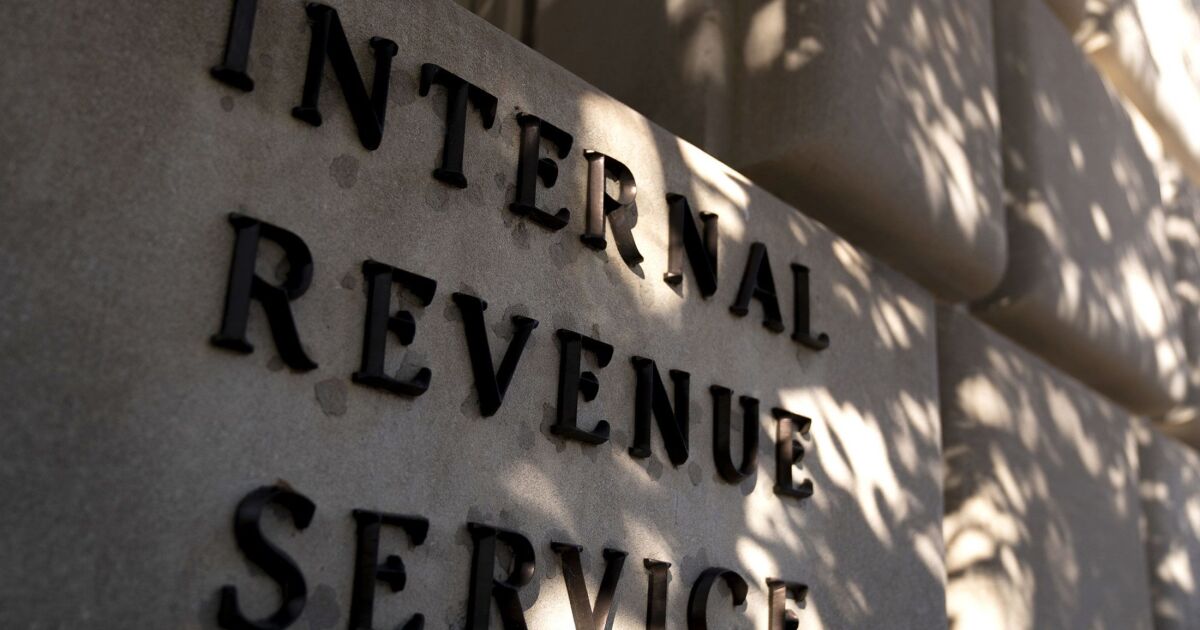
Inside Income Service IRS headquarters in Washington, D.C.
Stefani Reynolds/Photographer: Stefani Reynolds/B
Though tax season is formally over now, the company might get some pushback on that, nevertheless. The IRS started utilizing ID.me final November to authenticate taxpayers who needed to create new on-line taxpayer accounts as a strategy to fight id theft. Nevertheless, complaints quickly arose from privateness advocates in regards to the firm requiring taxpayers to make use of selfies for facial recognition and submit authorities paperwork akin to passports and driver’s licenses to the IRS (see story).
These considerations have been echoed in Congress and in February, the IRS allowed customers to decide out of the facial recognition biometric necessities and as an alternative provide a digital interview possibility with brokers (see story). The IRS mentioned it could additionally seek for alternate options to ID.me, which is extensively utilized by many state governments and different elements of the federal authorities.
IRS Commissioner Chuck Rettig was requested by lawmakers at a Senate oversight listening to Tuesday on the IRS price range in regards to the IRS’s plans to transition from ID.me to the federal authorities’s personal Login.gov service, however he famous that Login.gov doesn’t but have the capability to deal with all of the exercise that the IRS is used to getting on its on-line providers. Nevertheless, the IRS is working with Login.gov to enhance the authentication service’s capability.
“We have been receiving about one million folks every week attempting to create on-line accounts,” mentioned Rettig. “The system we had earlier than had a couple of 40% authentication price, so taxpayers who would attempt to authenticate that, sure, that is Chuck Rettig, however about 60% weren’t stepping into the system and needed to stroll right into a web site or name in.”
That was impractical when the IRS was coping with a backlog of thousands and thousands of tax returns to course of final yr. “With ID.me, the authentication price is much in extra of 70%, each on the biometrics half, which is facial recognition, however taxpayers have the choice to get on-line with a dwell ID.me individual,” mentioned Rettig. “Facial recognition is obtainable in eight completely different languages. The in-person is obtainable in additional than 30 completely different languages. We’ve got moved considerably from a service perspective into our multilingual efforts.”
He contrasted that to the present capability of Login.gov. “Login.gov can deal with lower than 30 transactions per second,” mentioned Rettig. “We want about 1,500 transactions per second. We want a Stage 2 authentication that when this individual is in, that is the individual.”
The IRS is different alternate options, Rettig famous, whereas additionally attempting to enhance the bandwidth at Login.gov. Within the meantime, ID.me will be capable of help the suite of e-Companies envisioned by the IRS. Nevertheless, the company has confronted information breaches in 2015 on a few of its self-service instruments akin to Get Transcript and Id Safety (IP) PIN and wanted to close them down so as to add higher authentication in 2016.
“Some folks suppose that fraud is any person sitting of their yard, however we’re up in opposition to nation-states,” mentioned Rettig. “We get 1.eight billion cyberattacks per yr, so to guard the info that folks belief us with, we now have to be at a better authentication degree, or not have so many choices accessible.”