
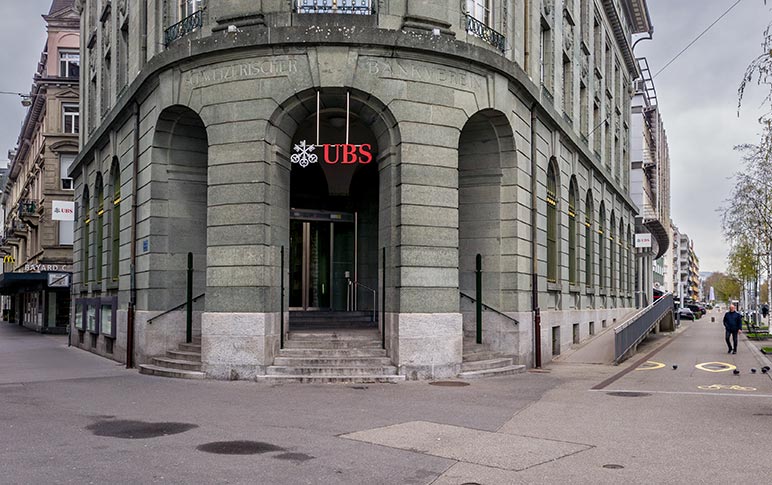
UBS Group AG moved one other step nearer to defeat within the long-running Swiss debate over how a lot capital it ought to maintain after its takeover of Credit score Suisse, with a parliamentary committee broadly backing the calls for of the federal government.
Lawmakers from the committee within the parliament’s decrease home on Tuesday supported a plan that may drive UBS to carry 90% CET1 capital towards its overseas models. The committee’s vice chairman, Paolo Pamini, mentioned the choice opens a path to a swift decision of the capital query, after the higher home already supported the measure.
“Earlier than Christmas, we might have 90% within the legislation after which UBS would have seven years to adapt,” the lawmaker of the right-wing Swiss Individuals’s Social gathering mentioned.
Switzerland has been looking for to reform its monetary regulation for the reason that collapse of Credit score Suisse in 2023, with a serious plank being a a lot larger capital buffer for the remaining world financial institution, UBS. The lender has fought bitterly towards the proposals, arguing they’ll make it uncompetitive. Chief Govt Officer Sergio Ermotti has opposed the newest proposal and signaled that the financial institution might finally exit Switzerland on account of the brand new guidelines.
“Right now’s suggestion by the committee would lead to an additional extreme tightening of Swiss capital necessities, that are already among the many most stringent globally,” UBS mentioned in an emailed assertion.
Tuesday’s choice is a suggestion to the decrease home, which can make the binding choice in a vote anticipated subsequent month. There’s no assure, nonetheless, that the chamber will comply with the lead of the committee.
Lawmakers will in all probability vote on a alternative between 75%, 90% and 100% fairness backing for the overseas models. The next quantity makes it much less doubtless that potential losses at a overseas unit may cause a extreme capital hit to the dad or mum financial institution in Switzerland.
A 90% capital backing is broadly according to what the federal government desires, although the committee backed a separate proposal asking the administration to contemplate altering the valuation technique for overseas models. That might probably make it cheaper for UBS to satisfy the upper capital necessities. No estimates can be found but on the affect.
“It’s potential that this implies a greater consequence for UBS with out creating a better danger,” mentioned Samuel Bendahan, chair of the decrease home’s financial affairs and taxation committee. Even probably the most hawkish members agreed that “we didn’t need to burden UBS for the sake of it,” he mentioned.
Lawmakers mentioned the change within the valuation technique was proposed in an effort to mitigate the quantity of additional capital that UBS has to search out on account of the modifications. However they careworn that the choice on the change ought to finally relaxation with the federal government.
Shares of UBS had been little modified at four p.m. in Zurich buying and selling.
The Swiss Bankers Affiliation criticized Tuesday’s choice, saying a requirement for a 90% capital backing goes far past what’s frequent in worldwide banking.
“It could weaken the competitiveness of the Swiss monetary middle, with penalties for the true economic system,” the foyer group mentioned on its web site.
Buyers and analysts have been break up over the problem, with some calling for UBS to contemplate relocating and others saying the talk is overblown. Algebris Investments mentioned it expects UBS to easily study to reside with the brand new necessities.
“We’re assessing the long run penalties for our potential to compete out of Switzerland,” Ermotti mentioned in October. Shoppers “respect Switzerland like we do — however a passport isn’t sufficient these days.”
UBS had $73 billion of CET1 capital on the finish of September. The entire capital requirement for overseas models at current is about 60%, however round 1 / 4 may be met with bonds referred to as AT1s.
The 90% rule would drive UBS to carry $16 billion in further CET1 capital, the financial institution has estimated. The federal government places the ensuing capital hole at $5 billion, although the projection elements in mitigating measures similar to shifting capital held overseas to Switzerland.
Pamini mentioned Finance Minister Karin Keller-Sutter — who participated in Tuesday’s committee assembly — signaled openness to take a look at altering the valuation technique.
Keller-Sutter “promised to go shortly and deeply into the problem,” he mentioned.